
THE REGULATORY FRAMEWORK FOR CLINICAL TRIAL AND CLINICAL INVESTIGATION
Ethical scandals matrix of regulation evolution
Part I : from Nuremberg to Helsinki
This article summarizes the evolution of regulations and the design of the modern regulatory system amid ethical scandals.
World War II – Human experiments involving torture, brutalities, and disabling injury [1]
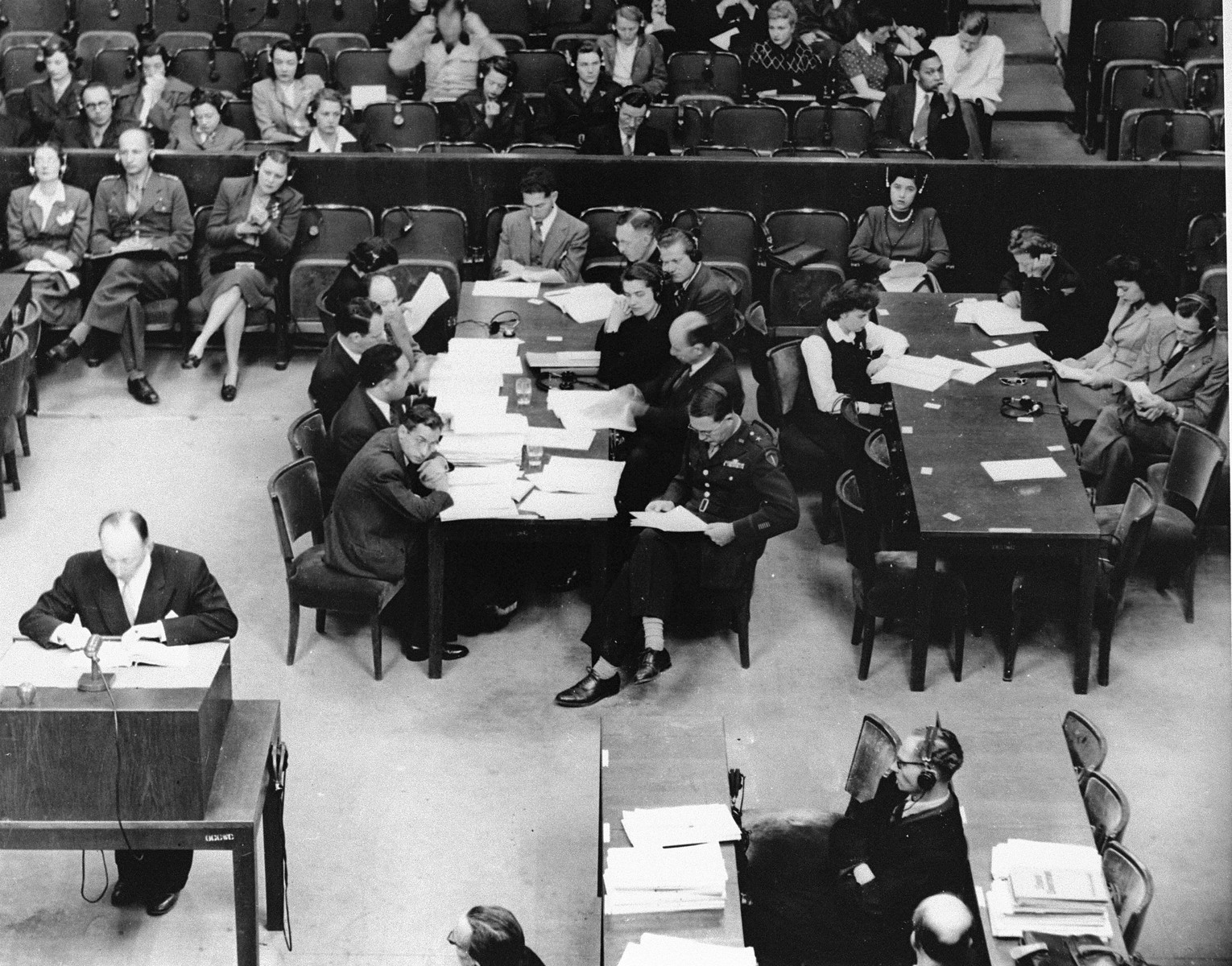
[2] View of the prosecution table at the Medical Case (Doctors') Trial in Nuremberg. Memorial Museum Photo Archives # 07348. Copyright: United States Holocaust Memorial Museum. Provenance: Hedwig Wachenheimer Epstein. Source Record ID: Collections: 1994.A.117 - This page: http://collections.ushmm.org/search/catalog/pa1036701
The roots of the regulatory framework trace back to the doctor’s trial, known as the Nuremberg Medical Trial (“The United States v. Karl Brandt et al. (the "Medical Case" or "Doctors' Trial", November 21, 1946, to August 20, 1947) [1]. During World War II, members of the Nazi party organized human experiments involving torture, murders, cruelties, and brutalities on prisoners in concentration camps. The judgment contains the well-known Nuremberg Code (Permissible medical experiments). In addition to the evidence presented at trial against the twenty-three defendants, most of whom were physicians, the judges formulated ten ethical principles that later became known as the Nuremberg Code. These principles served as a framework for assessing the legal and ethical permissibility of human experiments and for determining whether they constituted criminal acts.
The reorganization of the medical profession in the shadow of Nazi crimes.
The Nuremberg trial has greatly affected the image of the medical profession, underscoring the need to develop more robust universal medical ethical principles for the profession. This has led to the creation of the World Medical Association [3] in Paris on September 17, 1947, Pr. Eugène Marquis was appointed as the first president. Pr. Eugène Marquis was a well-known physician in Brittany (France), founder in 1923 of the Tumor Centre at the Pontchaillou hospice in Rennes, which was renamed the Eugène-Marquis Centre in 1953.
This marked the initial step of the association: modernizing the Hippocratic Oath with the Declaration of Geneva [4] in September 1948, which became known as the International Code of Medical Ethics. The text defines the Duties of Doctors in General, Duties of Doctors to the Sick, and Duties of Doctors to Each Other. This text was amended successively in August 1968, October 1983, September 1994, May 2005, and May 2006.
The increased amount of scientific research involving human subjects after World War II, accompanied by the rise of ethical questions, has underscored the need to develop specific ethical rules. This was not an easy process, but it involved more than 10 years of meetings and debates before arriving at a consensus. This led to the creation of the Declaration of Helsinki [5] in June 1964, which became a reference document in the conduct of clinical research. The text was successfully amended in October 1975, October 1983, September 1989, October 1996, October 2000, October 2002, October 2004, October 2008, October 2013, and October 2024. The text introduces basic principles and then differentiates between 2 types of experimentation: clinical research combined with professional care and non-therapeutic clinical research.
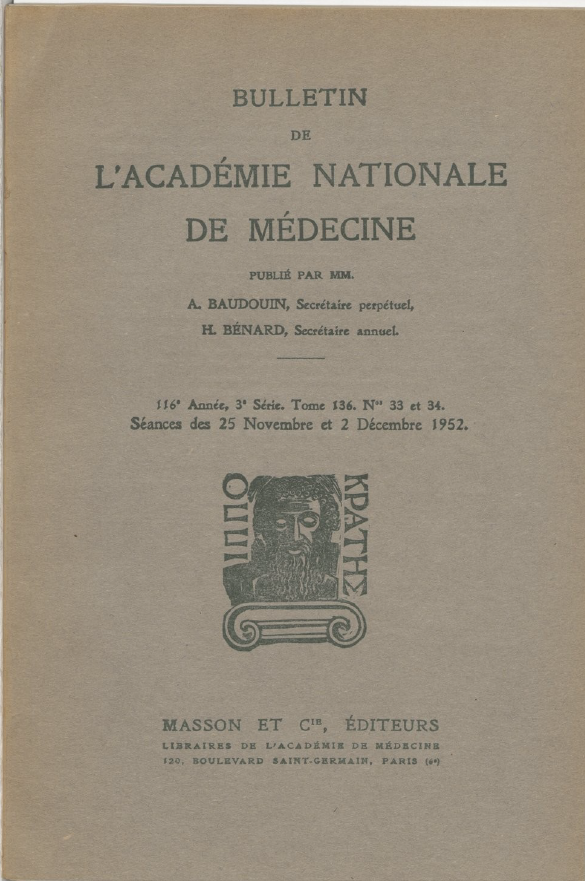
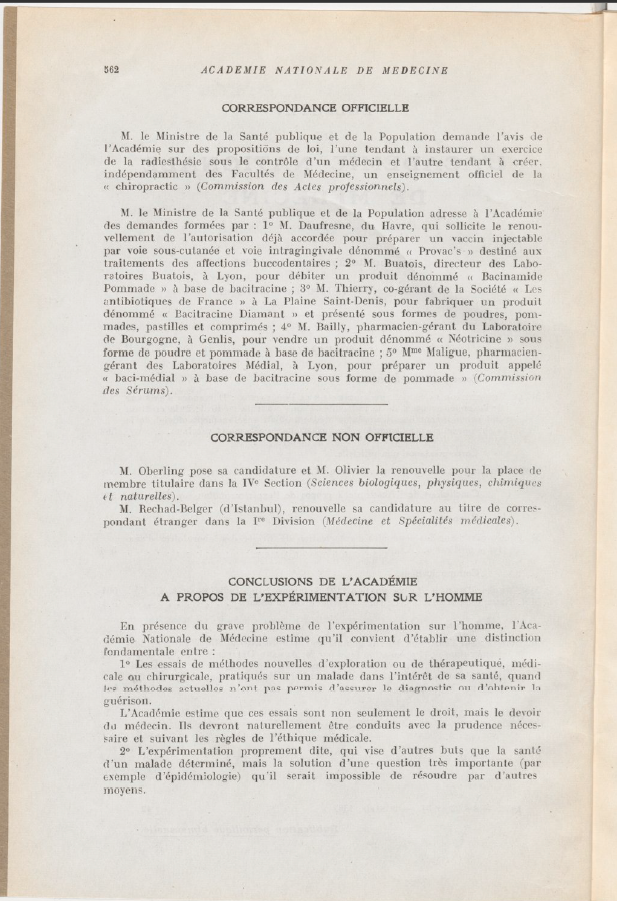
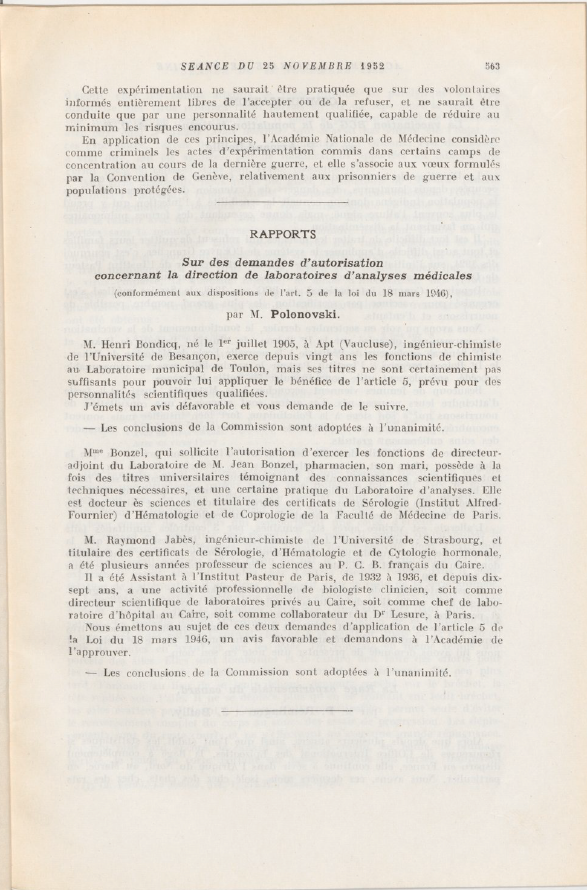
We can observe clear similarities with the conclusions of the French Academy of Medicine on the conditions governing human experimentation, published in 1952 [5]. The Academy distinguished therapeutic trials conducted in the direct interest of the patient and scientific experimentation undertaken primarily to advance medical knowledge. For the latter, it established several fundamental requirements: participants had to be informed volunteers, entirely free to accept or refuse participation, and the research had to be conducted by highly qualified investigators to minimize risks.
Source gallica.bnf.fr / Bibliothèque de l'Académie nationale de médecine
France JFS
Bibliography
1] https://www.legal-tools.org/doc/c18557/pdf
[2] View of the prosecution table at the Medical Case (Doctors') Trial in Nuremberg.Memorial Museum Photo Archives # 07348. Copyright: United States Holocaust Memorial Museum. Provenance: Hedwig Wachenheimer Epstein. Source Record ID: Collections: 1994.A.117
[3] https://www.wma.net/
[4] https://www.wma.net/policies-post/wma-declaration-of-geneva/
[5] https://www.wma.net/policies-post/wma-declaration-of-helsinki/